Millennials Less Promiscuous Than Any Generation for 60 Years. Here’s Why That’s TERRIBLE.

Image: Shutterstock.

Image: Shutterstock.

Some Christian news outlets are rejoicing at the recent study finding that Millennials are less sexually active than any other generation for the last 60 years. The perception by some is that this generation is experiencing a spontaneous outbreak of unusual moral fortitude.

Confronting the Nightmare

Would that it were so.  If you read the reports, the reasons Millennials give for not being interested in sex is that they are not interested in relationship at all.  Millennials appear to be so relationally broken that they would prefer to play video games, obsess over work, and dabble in porn rather than engage in any form of intimate relationship (not just sex) hardly counts as a win for our side. Rampant divorce, parental serial monogamy, an epidemic of absentee fathers, and households led by dual-parent workaholics. have killed this generation’s most basic, God-given desire for communion. It’s a nightmare.

Is It Porn?

Some commenters have suggested that this is the result of the porn epidemic.  That certainly doesn’t help, but that misses the larger point.  Under normal circumstances, even people who have a seriously compulsive relationship with porn historically indicated that a real relationship with a flesh and blood person would be preferable.  That isn’t the case with man Millennials.  The problem is much deeper.

Only the Godless Die Young

shutterstock_270541406

With apologies to Billy Joel, new research from Harvard shows that, irrespective of the state of their general health, only the godless die young.

Over the last 20 years, research has gradually accumulated suggesting that religious service attendance is associated with better physical and mental health. For example, research articles have indicated that regular religious service attendance is associated with a 30 per cent reduction in depression, a five-fold reduction in the likelihood of suicide, and a 30 per cent reduction in mortality, over 16 years of follow-up.

There have been a number of prior studies on religious service attendance and longevity. Many of these had been criticised for poor methodology, for instance allowing the possibility of reverse causation — ie, that only those who are healthy can attend services, so that attendance isn’t necessarily influencing health. 

Papers recently published out of Harvard University have tried to address this concern by using repeated measurements of service attendance and health over time to control for whether changes in health preceded changes in service attendance. The associations between religious service attendance and longevity, suicide and depression were all robust. Results indicated that compared with women who never attended religious services, women who attended more than once a week had a 33 per cent lower mortality risk during the study period. Those who attended weekly had a 26 per cent lower risk and those who attended less than once a week had a 13 per cent lower risk. (The data comes from women who worked as nurses in the US, most of whom identified as Catholic or Protestant, so most of the religious services would be at churches. However, the definition encompassed a range of different places of worship.)

NOT Just Social Benefits

Although historically researchers have suggested that the positive health benefits of religious involvement could be largely attributed to the social aspects of church attendance–socialization being an established contributor to well-being–more sophisticated statistical analysis shows that the social dimensions of faith account for only about 20% of the life-extending benefits of religion.  According to researchers…

Other mechanisms might also be operative. The development of self-discipline and a sense of meaning and purpose in life have been proposed in the literature as potential factors. The association between service attendance and health seems not to be explainable by just one mechanism alone. Rather, there appear to be many pathways from religion to health. Religious service attendance affects many aspects of a person’s life and the cumulative effect of all of these seems to have a substantial influence on health.

Of course, studies can’t statistically account for, y’know, that grace thingy.

“Spiritual Not Religious” Dying Sooner As Well.

The research also had some bad news for all the “spiritual but not religious” folks out there…

it appears to be religious service attendance, rather than self-assessed religiosity or spirituality or private practices, that most powerfully predicts health. 

You can read the rest here.  For more on how you and your kids live longer more faithful lives, check out Discovering God Together: The Catholic Guide to Raising Faithful Kids.

What Faith Stage Are You? The 6 Stages of Seeking Meaning, Significance, and Transcendence.

shutterstock_209641291

The following article is adapted from Discovering God Together:  The Catholic Guide to Raising Faithful Kids

Most people think that faith is something you either have or you don’t.  But research by Emory University’s Dr. James Fowler revealed that faith evolves in discernible stages throughout our lifespan.  At each stage, a person’s faith needs to be nourished in different ways if it is to grow and mature into the next stage. If we don’t receive the right kind of support, faith development can stall or even wither.  Because Fowler viewed faith as a natural and essential part of every human person’s search for meaning, significance, and transcendence, Fowler’s Stages of Faith track with other developmental stages you might remember from your Psych 101 class, such as Erik Erikson’s Stages of Psychosocial Development and Lawrence Kohlberg’s Stages of Moral Development.

What Stage of Faith are you at?  And what do you need to do to more effectively continue your search for meaning, significance, and transcendence?

STAGE 0: Primal Faith (Infancy)–  People might be surprised to realize that babies have faith.  It’s true that they don’t have a conscious experience of faith and can’t articulate specific beliefs,  but this stage is tremendously important because it sets the stage for baby’s view of God and the world.  If parents respond to baby’s needs promptly, generously, and consistently, baby learns the basic, gut-level sense of trust that is necessary to believe that when I call out, God will answer. If parents delay responding to baby’s cries, baby develops gut-level insecurity that anyone will respond when I cry out or that there is anyone to bother crying out to in the first place.

Stage 1: Intuitive Projective Faith (Early Childhood)–This is the “feeling stage” of faith.  Children of this age are not capable of abstract thinking.  They understand everything in terms of “does it feel good or does it feel bad?”  Parents do well to make the child’s experience of faith at this stage as warm, loving, pleasant, and even “cuddly” as possible.  Whether or not a parent does this determines whether the child envisions the idea that “God is watching over you” as a positive, loving, and safe thing (“How wonderful, a loving God is looking out for me!”) or a judging, condemning, scary thing (“I always feel like somebody’s watching me!“).  Everyone eventually outgrows Stage 0 and Stage 1 but the gut-level lessons they take from these stages often stay with them throughout their lives, making faith development a joy or a constant struggle depending upon the experiences they have had up to this point.

Stage 2: Mythic-Literal Faith (Primary School Age to Adulthood)– This is the “story stage.”  The stage of fables and bible stories and rules.  These stories and rules form the basic structures of a child’s faith system.  At this stage, God is a “person” in the same sense that Superman or Santa Claus is a person.  A “larger than life” being with superpowers to help him maintain order in the universe.  Again, depending on how parents present their own faith story (i.e., how they live and explain their own faith life to their kids), God could either be perceived as a benevolent ruler of the universe or a tyrant.  Either way, for the person at this stage, following the rules, doing things “just so” and working hard not to upset God are the prime motivators and primary ways faith is expressed. Generous amounts of parental affirmation allow the person to move through this to the next stage.  By contrast, adults who become stuck at this stage tend to be fairly scrupulous in their approach to faith and overly concerned with liturgical rules, moral rules, and proving themselves to be “good enough”.  For these individuals, faith can become an exhausting trial of constantly trying to prove themselves to God or the people they imagine to be the “official judges of goodness.”

Stage 3: Synthetic Conventional Faith (Adolescence to Adulthood)— This is the “relationship stage” of faith.  A person at this stage tends to decide that something is “true” if it makes their relationships easier and makes people feel affirmed.  By contrast, it is “false” if it makes relationships more complicated or makes people feel challenged or guilty in some way. The hard and fast rules of the mythic-literal stage are now revisioned in light of one’s relationships and the need to affirm others where they are at in their present struggles. Many adults remain at this stage for their entire lives.  Community is very important at this stage.  The down side of this is that faith can be a bit tribalistic (i.e., us v. them), even within a particular denomination.  A faithful, supportive community will enable people to sustain their faith at this stage, the absence of such a community,or the presence of an angry, judgmental community could cause the loss of faith.  Regardless, a person will tend to be faithful to the degree that the people around them are faithful and affirming of their efforts.  They have a harder time feeling confident in their faith and values without a cheering section.

Stage 4: Individuative-Reflective Faith (Early-Middle Adulthood)–This is the “Questioning and Seeking” stage of faith.  The person at this stage owns their faith, is not worried about whether people approve of them or not, and begins questioning many basic assumptions they had previously accepted as gospel.  The person at this stage is “kicking the tires” of their faith, asking hard questions to see what will stand and what may fall away.  Often the people around this individual consider them to be backsliding and are threatened by this individual’s willingness to question the structures of rules and relationships that people at the lower stages of faith need to hold onto for security. At this stage, the person is much more concerned with internal conversion than with outward expressions of piety and righteousness. They tend to withdraw a bit from others, both needing less affirmation and more time to reflect and consider where they are in their journey and who God is asking them to be moving forward. The downside is that they can be a bit smug, looking down their noses at those who they consider to be less evolved. The other danger is that many people at this stage come to believe that the act of questioning is an end in itself and that actually finding actual answers is somehow beneath them.  The process of “seeking and questioning” though imminently valuable and necessary, can become its own idol.  In classic terms, this stage marks the end of the Purgative Way and the beginning of the Illuminative Way.

Stage 5: Conjunctive Faith (Middle-Later Adulthood)–This is the “wisdom stage” of faith.  The person at this stage has achieved what seems to others to be an almost effortless integration of their faith and life.  Things seem, somehow, genuinely less messy for them than for other’s lives.  Others may be tempted to write this off as “luck” but in reality, this is the result of decades of struggle and effort.  The person at this stage has achieved a true, authentic, integration between what they profess and how they live.  This is essence of wisdom; the practiced knowledge of how to live their beliefs–authentically, honestly, and effectively–in the real world.  People at this stage aren’t interested in proving anything.  They also experience a “willed naivety” which allows them to revisit beliefs and practices that they formerly rejected as somehow beneath them.  Also, unlike people at the answer-phobic individuative-reflective stage, people at the conjunctive stage accept that although there may not be perfect answers to the “Big Questions” there are often “very good answers” that are almost universally applicable.  In classic terms, the person at this stage is squarely in the Illuminative Stage of the spiritual walk and perhaps the beginning of the Unitive Stage.

Stage 6: Universalizing Faith (Later Adulthood)–For want of a better way to describe it, this is the “saintly stage.”  Without any attempt on their part to put on a show,  people at this stage are acknowledged by those around them for being living, breathing, examples of faith and virtue and an inspiration to others. People at this stage can still be polarizing and challenging to others, but there is a compassion that comes with these challenges that tempers any sense of condemnation others may feel. There is a simplicity to outward expressions of this person’s faith that belies the depth of belief and wisdom that lies beneath the surface. This person is in at least the beginning stages of the Unitive Way.

So, what stage are you?  Where would you like to be? Negotiating the challenges of these stages can be difficult on our own.  That’s where a spiritual director can be a great help.  If you’d like to learn more about how spiritual direction can help you navigate the challenges of these stages and achieve greater confidence in your spiritual walk, contact us at SpiritualDirection@CatholicCounselors.com  And, for a more in-depth look at each of these stages and how you, as a parent, can help your kids grow up to have a healthy, mature faith, check out, Discovering God Together:  The Catholic Guide to Raising Faithful Kids

 

More2Life Radio Coming to EWTN Radio Network & SIRIUS/XM Channel 130 @ 10amE/9amC

Photo Credit: More2Life Radio. Used with Permission

Photo Credit: More2Life Radio. Used with Permission

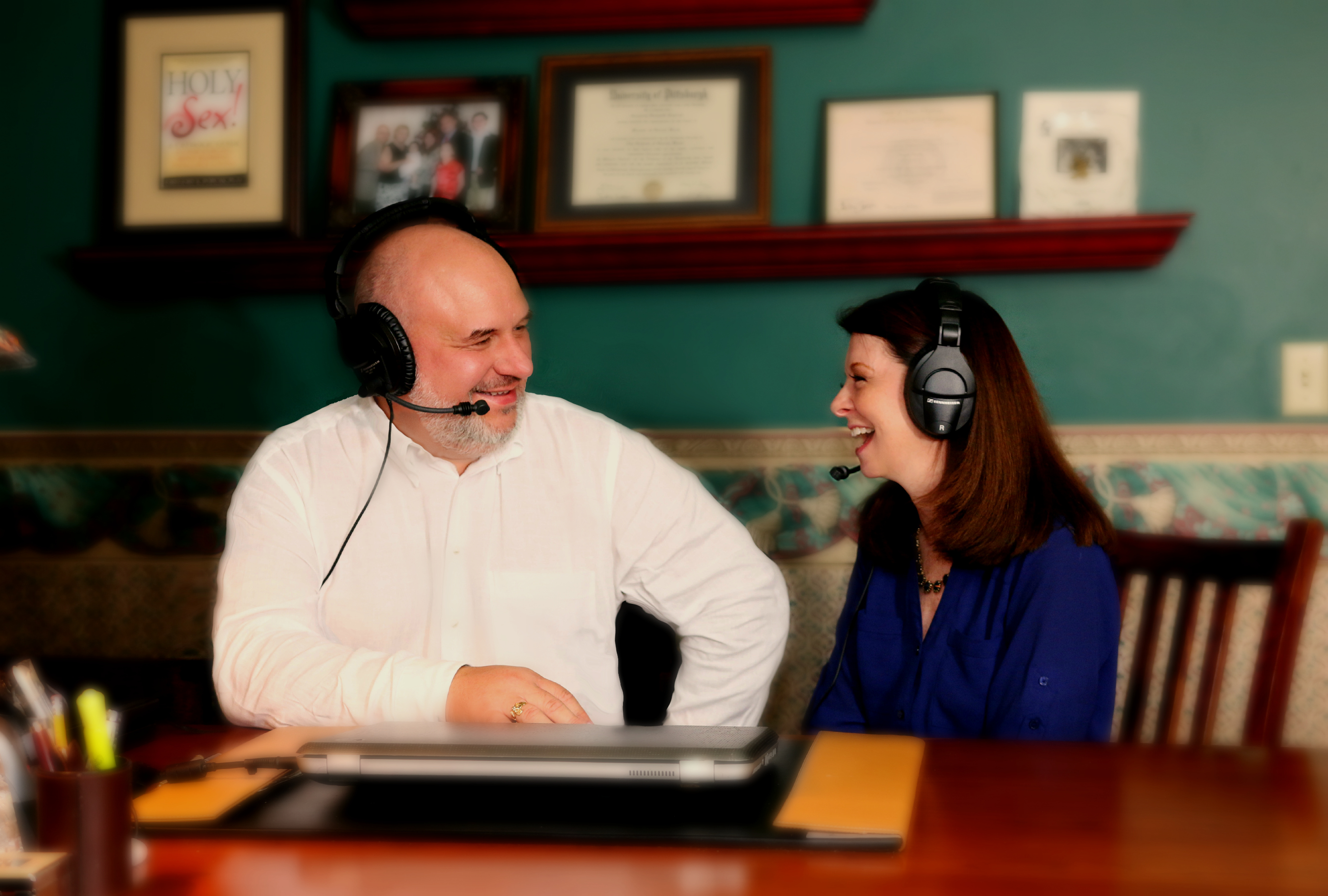
EWTN Radio announced today that they will begin airing More2Life with Dr. Greg and Lisa Popcak each weekday at a new time, 10am Eastern/9am Central, beginning August 15th, 2016.  More2Life is a call-in advice program integrating insights from counseling psychology and St John Paul the Great’s Theology of the Body (TOB).   Mike Jones, Vice-President of Ave Maria Radio, the producers of More2Life, said that they were excited to be bringing More2Life to EWTN’s almost 400 affiliated stations across the US as well as the EWTN Channel 130 on Sirius Satellite Radio.

Airing weekdays on about 50 stations affiliated with Ave Maria Radio since 2001, More2Life is dedicated to helping people live the  Catholic difference in their marriage, family, and personal lives and overcome the obstacles we face to becoming the whole, healed, godly, and grace-filled people we are all meant to be.

More2Life offers a faithful take on current events and the latest insights from counseling psychology, viewing the world through the lens of the Theology of the Body—that dynamic teaching of St. John Paul the Great that has been called “a theological time bomb,” with the potential to revolutionize how the world thinks about faith, life, and love in the third millennium.

In addition to sharing helpful tips and responding to listeners’ calls about challenging marriage, family, and personal problems, Dr. Greg and Lisa Popcak are joined by a rotating list of dynamic TOB guest experts including…

Bishop Jeffrey Monforton, Bishop of Steubenville and former rector of Sacred Heart Seminary.

Dr. Andy Lichtenwalner & Bethany Meola Exec. Dir. and Asst. Dir. (respectively) of the USCCB Secretariat for Marriage, Family, Laity and Youth.

Fr. John Riccardo, popular speaker, pastor, and host of Christ is the Answer

Dr. John & Claire Grabowski, members of the Pontifical Council for the Family

Dr. Joseph White, family psychologist & national catechetical consultant for OSV Publications.

Damon Owens, former Exec. Dir. of the TOB Institute and Founder of JoyToBe Ministries.

Bill Donaghy, head of curriculum development for the TOB Institute

Emily Stimpson, author of These Beautiful Bones:  An Everyday Theology of the Body

Rachel Watkins, developer of the Little Flowers Girls Club and mom of 11.

In addition to hosting More2Life Radio, Dr Greg and Lisa Popcak are the authors of more than 20 books that apply timeless Catholic wisdom and cutting-edge psychological insights to the challenges of marriage, family, and everyday life.  Together, they are the founders of the Pastoral Solutions Institute, an internationally-recognized Catholic tele-counseling practice providing over 12,000 hours of counseling services each year to Catholics around the world. They were featured speakers at the 2015 World Meeting of Families in Philadelphia and are winners of the Couple to Couple League International’s Fr. Richard M. Hogan Award for their work promoting the Catholic vision of marriage and sexuality.

Dr. Greg Popcak is a Fellow of the American Association of Pastoral Counselors and the Chair of the Marriage and Family Studies  program at Holy Apostles College and Seminary. He also holds teaching positions on the psychology and graduate theology faculties at Franciscan University of Steubenville.

Lisa Popcak is a Certified Family Life Coach, a Lactation Consultant, and professional educator with specializations in learning styles and early childhood development, adoption, and attachment.

They have been married 27 years and are the parents of three children.   They are popular guests on many Catholic radio and television programs and their work has been featured in the LA Times, Washington Post, Ladies Home Journal, NPR, USA Radio Network, FoxNews, and many other outlets.

Imagining the Future Helps Couples Resolve Present Arguments More Easily

Image Shutterstock

Image Shutterstock

A new study published in the journal  Social Psychological and Personality Science found that thinking about the future helps couples focus on their feelings and reasoning strategies.

 “When romantic partners argue over things like finances, jealousy, or other interpersonal issues, they tend to employ their current feelings as fuel for a heated argument. By envisioning their relationship in the future, people can shift the focus away from their current feelings and mitigate conflicts,” said researcher Alex Huynh.

Previous research has shown that taking a step back, and adopting a distanced fly-on-the-wall-type of perspective can be a positive strategy for reconciliation of interpersonal struggles. Huynh and his collaborators investigated whether similar benefits in reasoning and relationship well-being can be induced by simply stepping back and thinking about the future.

Study participants were instructed to reflect on a recent conflict with a romantic partner or a close friend. One group of participants were then asked to describe how they would feel about the conflict one year in the future, while another group was asked to describe how they feel in the present.


The researchers found that thinking about the future affected both participants’ focus on their feelings, and their reasoning strategies. As a result, participants reported more positivity about their relationship altogether.

In particular, when study participants extended their thinking about the relationship a year into the future, they were able to show more forgiveness and reinterpret the event in a more reasoned and positive light.

Responding to conflict is a critical skill for relationship maintenance.

“Our study demonstrates that adopting a future-oriented perspective in the context of a relationship conflict — reflecting on how one might feel a year from now — may be a valuable coping tool for one’s psychological happiness and relationship well-being,” said Huynh.

The research also has potential implications for understanding how prospection, or future-thinking, can be a beneficial strategy for a variety of conflicts people experience in their everyday lives.

For more great ideas for dealing more effectively with marital conflict check out For Better…FOREVER!  and When Divorce is NOT An Option:  How to Heal Your Marriage and Nurture Lasting Love or contact the Pastoral Solutions Institute (740-266-6461) to learn how our telephone counseling practice can help you have a more peaceful, loving marriage.